Fife
Hide and SeekFife is more than a point on the map in the novel: its open, wind-beaten terrain provides cover for an underground dog-fighting operation, while its closing mines and dwindling work give the region a harder economic edge. The visits of Brian Holmes and John Rebus connect these contrasting aspects of the place, from a remote field to the working landscape around the Forth.
Terrain and Atmosphere
Fife first appears through a wary exchange about its bleakness. Charlie allows that only the more picturesque parts are bleak, leaving the judgment suspended between dry humor and the landscape itself. In Holmes’s visit, the setting is less a scenic view than a stretch of exposed ground: at twilight, an almost completely flat field is broken by a dead tree, and a fierce, cold wind sweeps across it. The Scottish Society for Prevention of Cruelty to Animals officer calls the wind an “aist wind.” Holmes takes this to mean an east wind, although he thinks it is blowing from the west, a small disagreement that makes the place feel remote even in its ordinary details.
The field’s isolation is not simply atmospheric. The planned dog-fighting venue lies half a mile from the main road and a mile from the nearest house. Its distance from both public traffic and nearby residents makes the bleakness functional: the very openness and seclusion that make the site feel desolate also help conceal what is expected to happen there.
The Planned Raid
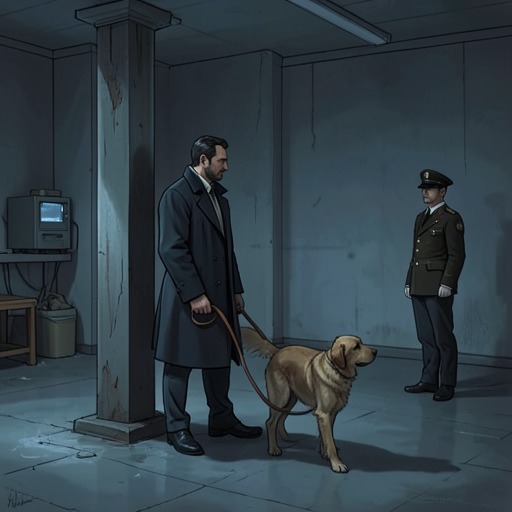
Holmes is guided across the field by an officer from the Scottish Society for Prevention of Cruelty to Animals. Detective Sergeant Hendry explains that police have received a good tip about a dog fight expected that night. A track leading from the main road to the site offers a likely route in: three or four vans may carry the dogs, followed by an unknown number of cars bringing spectators. Hendry says the operation is chiefly intended to catch the handlers, rather than to arrest the people who come to watch; if the crowd reaches the scale of an event at Ibrox, reinforcements will be called.
The suspected organizer is Davy Brightman, who owns scrap yards in Kirkcaldy and Methil and is believed to keep and fight pit bulls. The account establishes the planned operation and its target, but does not describe the raid’s full course or outcome. Fife’s secluded field thus enters the narrative as a place where criminal activity depends on distance, access, and the ability to gather unseen.
Holmes’s Visit and Rebus’s Return
Holmes later tells John Rebus that he had to leave before the bust and did not think he had impressed the team he was meant to join. He identifies Hendry as the young detective sergeant in charge. His brief involvement leaves the raid itself largely offstage: Holmes reaches the remote setting and learns the plan, but is gone before its decisive action.
Rebus’s later journey gives Fife a different narrative function. When asked where he is, he answers that he is in Fife because Calum McCallum is there. Rebus drives from Edinburgh, crosses the Forth Road Bridge after paying the toll, and takes time to look at the view. He is heading toward information about Hyde, and his urgency eventually overtakes the moment of looking: he accelerates because he expects Calum to want a bargain in exchange for what he knows.
Work, Decline, and Narrative Significance
The view from the bridge opens onto a region marked by diminishing work. Rosyth Naval Dockyard lies below Rebus on his left; he recalls that many of his schoolfriends found jobs there and may still be working there. In his assessment, it seems almost the only place in Fife where employment remains available. The mines, by contrast, are closing with enforced regularity, while men continue digging for coal beneath the Forth along a curve of decreasing profitability.
These observations give the region a social and economic dimension without separating it from the plot. The field’s isolation supports the secrecy of the anticipated dog fight; the industrial details place Rebus’s journey in a landscape where familiar sources of work are contracting. Fife is therefore both an operational setting and a region in transition, encountered through the different purposes of Holmes’s police work and Rebus’s pursuit of a lead.